

You buy the green-labeled bags. You tie off each little bundle on your morning walk and drop it in the nearest trash can, feeling marginally better about the whole routine. Roughly 36% of the U.S. population has access to some form of curbside or drop-off composting. This means you need a different decision framework. One built around what actually happens to these bags after you throw them away, not what could happen in an ideal scenario.
The Composting Gap Nobody Talks About
The word "compostable" on a dog waste bag refers to a specific outcome: the bag will break down in an industrial composting facility within 180 days, leaving behind no toxic residue. That standard is defined by ASTM D6400, and products that meet it can earn certification from bodies such as BPI in North America or TÜV Austria's OK Compost mark in Europe.
Industrial composting requires sustained temperatures above 131°F, consistent moisture levels, and active aeration, conditions that no landfill provides. And even facilities that meet those conditions overwhelmingly refuse pet waste. Dog feces carry pathogens like Salmonella, E. coli, and Giardia, and composting operators don't want the liability. Approximately 23 million E. coli bacteria per gram of dog feces, roughly twice the bacterial density of human waste.

Where Pet Waste Composting Does Work
Several Canadian provinces accept pet waste in curbside organics programs, and BPI still certifies dog waste bags for the Canadian market. In the U.S., a handful of pilot programs exist. Battery Park City in New York ran a dedicated dog waste composting initiative starting in 2019, processing about 1.4 cubic yards of waste in its first composter, but these remain rare experiments, not systemic solutions.
Even cities routinely praised for composting leadership, such as San Francisco, which mandated composting in 2009, and San Diego, which provides composting bins with weekly pickup, exclude dog waste from their organics streams. New York City's mandatory food composting program, rolled out in 2025, explicitly excludes the waste produced by the city's estimated 600,000 dogs, roughly 82,125 tons per year.
What "Compostable" and "Biodegradable" Actually Mean on a Label
This distinction matters more than most pet owners realize, and getting it wrong costs you money while delivering zero environmental benefit:
- Compostable is a regulated term backed by testing standards. In the U.S., ASTM D6400 requires that a product disintegrate and biodegrade at a rate comparable to known compostable materials, like leaves or food scraps, under industrial composting conditions. The product must also leave no harmful residues in the resulting compost. When you see "ASTM D6400" or the BPI logo on packaging, a third party has verified those claims in a lab.
- Biodegradable carries no standardized meaning. Technically, everything is biodegradable given enough time — a conventional plastic bag will biodegrade, it'll just take 500 years. Federal Trade Commission flagged this exact issue in 2015 when it sent warning letters to 20 dog waste bag manufacturers, stating that unqualified "biodegradable" claims may be deceiving consumers. Under the FTC's Green Guides, an unqualified "biodegradable" claim implies that a product will completely break down within one year of customary disposal. Most bags making this claim don't come close.
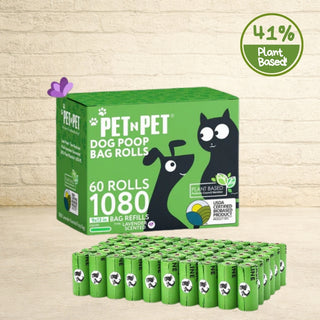
Many bags labeled "biodegradable" are made from petroleum-based plastic treated with chemical additives designed to accelerate fragmentation. Compostable bags are typically made from plant-derived polymers such as PLA (polylactic acid, usually derived from corn starch) and PBAT (a biodegradable copolyester). Poop Bags manufactures ASTM D6400-certified bags from plant matter, including corn and vegetable oils, with options ranging from 41% plant-based formulations to USDA Certified Biobased bags with significantly higher renewable content.
What Actually Happens to Your Bag in a Landfill
The Methane Problem
Dog waste itself produces methane during anaerobic decomposition, and methane traps atmospheric heat roughly 25 times more effectively than carbon dioxide over a 100-year period. With an estimated 89.7 million dogs in the United States, each producing between half a pound and three-quarters of a pound of waste daily, the cumulative methane contribution is significant, though precise figures remain debated among environmental scientists.
The EPA classified pet waste as a nonpoint source pollutant back in 1991, placing it in the same regulatory category as herbicides, insecticides, and toxic runoff from motor vehicles. When dog waste reaches waterways, which happens easily during rainstorms, since most storm drains flow directly to lakes, streams, and marine waters without treatment, the bacterial and nutrient loads can temporarily close beaches and shellfish harvesting areas within a 20-mile radius.
Why Material Composition Still Matters
Even when a compostable bag ends up in a landfill, its material composition affects its long-term environmental footprint differently than conventional plastic. A petroleum-based bag with Oxo-degradable additives fragments into microplastics. A plant-based bag certified to ASTM D6400 may not decompose quickly in a landfill, but its base materials don't fragment into persistent synthetic microplastics the same way. The bag still takes a long time to break down. But what it eventually breaks down into is meaningfully different. But when you're choosing between two bags that both end up in a landfill, the downstream chemistry of their materials is one of the few variables you can actually control.
A Decision Framework for Choosing the Right Bag
The "right" compostable bag depends almost entirely on what disposal options are actually available to you. Here's a step-by-step framework for making that choice:
- Audit your local waste infrastructure. Check whether your municipality accepts pet waste in its organics program. Call your waste hauler directly. Don't rely on the general composting FAQ on your city's website, which often describes food scrap programs without specifying pet waste exclusions. If pet waste is accepted, buy ASTM D6400-certified bags and use the organics bin.
- If composting isn't available, prioritize plant-based materials over "biodegradable" marketing. Look for bags made primarily from PLA, PBAT, or other plant-derived polymers. The higher the plant-based content percentage, the less petroleum-derived material enters the waste stream. Poop Bags offers a useful benchmark here, with its ASTM D6400-certified compostable line manufactured in the USA.
- Demand third-party certification, not self-reported claims. ASTM D6400 compliance, USDA Certified Biobased labels, and the OK Compost mark all require independent lab verification. A bag that says "eco-friendly" without any of these marks is making a marketing claim, not a scientific one.
- Consider landfill-optimized alternatives if they become available in your area. Some newer products are engineered specifically for anaerobic landfill conditions, using proprietary additives that attract microbial colonies already present in landfills. Lab testing on some of these products suggests full biodegradation within 28 months in anaerobic environments, a dramatic improvement over conventional or compostable plastics, though independent, long-term field data remains limited.
- Factor in the full supply chain, not just end-of-life. A plant-based bag made from renewable crops has a lower carbon footprint during manufacturing than a petroleum-derived bag, even if both end up in the same landfill. The environmental benefit of choosing plant-based materials begins at production, not disposal.

How to Spot Greenwashing on Dog Waste Bag Packaging
Greenwashing in this category remains widespread because the terms are confusing, and consumer expectations are high. Here's what to watch for:
- "Biodegradable" with no certification mark. Under the FTC's Green Guides, this claim implies a full breakdown within one year of normal disposal. No dog waste bag in a landfill meets that bar. If the bag doesn't specify a testing standard (ASTM D6400, EN 13432, or AS 4736), treat the claim with skepticism.
- Vague percentage claims. A bag advertised as "38% vegetable-based" leaves 62% unaccounted for — and that 62% is likely petroleum-derived plastic. Ask what the remaining materials are. Reputable manufacturers, like The Original Poop Bags®, disclose their material composition and carry third-party certifications to back it up.
- "Breaks down faster than regular plastic." Faster than 500 years is a low bar. This claim tells you nothing about what the bag breaks down into or under what conditions.
- Green packaging with no substance. Leaf icons, earth tones, and words like "eco" and "earth-friendly" are design choices, not certifications. Look past the aesthetics and read the fine print.
- "Home compostable" claims for pet waste bags. Even if a bag meets home compostability standards, composting dog waste at home requires sustained temperatures of 145°F or higher to kill pathogens — conditions most backyard bins never reach. The FTC has noted that most consumers lack the equipment and knowledge to safely home-compost pet waste.
When You Can't Compost: Practical Alternatives That Reduce Your Impact
Pick Up Every Time
Before worrying about bag materials, the single highest-impact action is consistent pickup. Dog waste in nature reserves injects an extra 11 kilograms of nitrogen and 5 kilograms of phosphorus per hectare annually, levels high enough to disrupt sensitive ecosystems. The same research found that picking up waste removes 97% of the phosphorus and 56% of the nitrogen. The bag you use matters far less than whether you use one at all.
Seek Out Community-Scale Solutions
A growing number of dog parks and municipalities are experimenting with dedicated pet waste composting or anaerobic digestion systems. These localized programs bypass the scalability problems of municipal composting by handling pet waste in purpose-built infrastructure. Anaerobic digesters can process pet waste alongside food scraps to generate biogas, turning a waste problem into an energy source. Several universities and municipal parks departments have piloted these systems with promising early results, though scaling them beyond demonstration projects remains an ongoing challenge.
If your community doesn't have one, advocating for a pilot program at your local dog park may deliver more environmental value than any individual purchasing decision. Contact your city council member or the parks department and reference successful models such as the Battery Park City initiative. Concrete examples carry more weight than abstract requests.
Pair Your Bag Choice with Broader Waste Reduction
The average dog requires nearly 10,000 plastic bags for waste disposal over its lifetime. Reducing that number, through larger bags used for multiple pickups on a single walk, or thinner-gauge bags that use less material per unit, creates tangible waste reduction even when every bag ends up in a landfill.
Making a Choice That Matches Reality
The compostable dog poop bag market is built on a well-intentioned but deeply flawed assumption: that buying a compostable product means it will be composted. For most American dog owners, it won't be. The infrastructure isn't there yet. But that gap between intention and infrastructure doesn't make the choice meaningless. A dog owner who buys ASTM D6400-certified, plant-based bags from a transparent manufacturer is still making a materially different choice than one who grabs the cheapest petroleum-based option. The plant-based bag reduces fossil fuel demand during production. Its end-of-life breakdown products are less environmentally persistent. And the purchase signals market demand for better materials.

Check your local composting access. If it exists for pet waste, use it with certified bags. If it doesn't, and for most of us, it doesn't, choose bags with the highest plant-based content, verified by third-party certification, from manufacturers who are honest about what their product can and can't do. Skip the greenwashing. Pick up every time. And push for the local infrastructure that closes the gap between what these bags are designed to do and what actually happens to them. That's not a perfect solution. But in a space crowded with misleading labels and wishful thinking, it's the most honest one available. The dog waste bag you choose is a small decision you make hundreds of times a year. Making it well, with clear eyes about what's possible and what isn't, adds up.
Sources:
- Compostable Dog Poop Bags Aren't Really That Compostable — TIME
- Dog Poop Pollutes. Here's Why You Should Pick It Up — Popular Science
- FTC Staff Warns Marketers and Sellers of Dog Waste Bags — Federal Trade Commission
- Composting Maps: Urban Access — Sustainable Packaging Coalition
- Scoop the Poop: It's Your Environmental Doody — University of Washington School of Marine and Environmental Affairs
- Environmental Claims: Summary of the Green Guides — Federal Trade Commission
- BPC Dog Waste Compost Application — Battery Park City Authority
- Compostable Certifications Explained: BPI, TÜV, ASTM D6400 Guide — Orizon Bio